

I love long-distance train travel. It's hard to say exactly why, but the longer the journey the better.
On the train, you enjoy relative comfort and the ability to move around more easily. On long-distance trains, you will usually have some kind of bedroom or cabin with at least a degree of privacy. You'll live in your own little bubble, should you choose to.
To paraphrase TS Eliot, your days and nights will be measured out with coffee spoons - and the occasional stop for fuel, water or a crew change; a walk along a deserted platform at 3.37am; or a conversation with a platform food vendor.
It could be a city or in the middle of nowhere: deserts, mountains, prairies. It could be -30℃ or warm and balmy with torrential rain, or even a sandstorm.
The soundtrack of your life will become the arhythmic clattering of train wheels over rails, bell chimes at level crossings or the sudden howitzer whoosh of a train passing at speed.
The countryside will roll past at a pace that makes sense; you can watch the geography unfold and evolve observing how, in doing so, it aligns to the culture and behaviour of those who live there.
During the day, you can take a nap anytime, read or listen to music, Or, as I'm doing now, gaze out of the window while writing and thinking.
Later, you can go to the bar for a drink and to meet fellow travellers. Dining tables are shared so you will always meet new people, and the food will often be much better quality than you were expecting, although it can also be much, much worse!
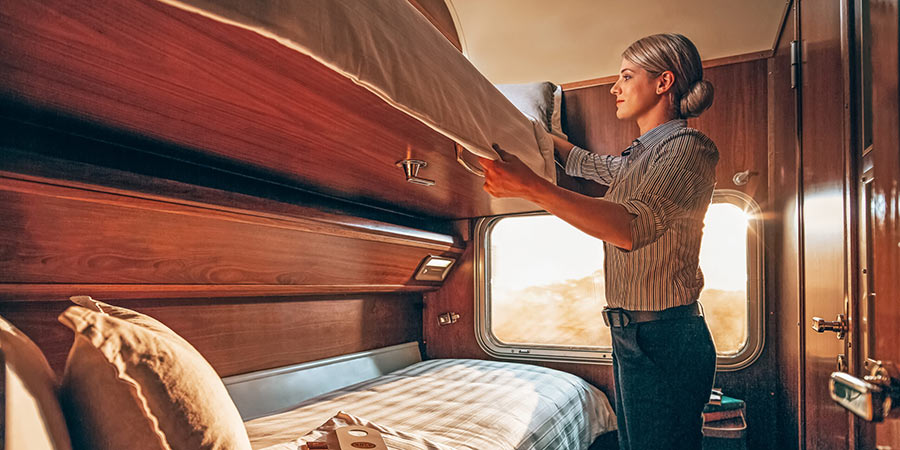
What to expect on sleeper trains
If you travel by long-distance rail, at some point you're going to need to sleep. This will take a bit of practise to get right.
If you're expecting your sleeper train to be like those in Murder on the Orient Express or North by Northwest - trains that neither move nor make noise - then you're in for a surprise. Eventually, you will drop off to sleep and you'll do so with better quality than on an aircraft. If you're on a multi-night journey, by the second night you'll sleep like a veteran. I've travelled on quite a few sleeper trains, including Canada, USA, Australia, Vietnam, Germany, Poland, Scotland, Spain and Siberia. In doing so, I've learned a few tricks, so here are a few suggestions that will help you settle into your cabin and get the most from your journey.
As soon as you get in your cabin, unpack, hang up clothes, lay out toiletries and generally get prepped and ready for the morning. That way, you can sleep in as long as possible without having to mess around looking for stuff in a hurry.
Find out if there is stowage for your suitcase (usually under the lower bunk). Your suitcase may be checked into a separate luggage car and so not be accessible during the journey so an overnight bag would be essential.
If there is an instruction/information card, read it! You'll often find facilities in the cabin that are not immediately obvious; hidden controls for air-con and heating, power sockets, reading lights and rubbish disposal. This will be your home for at least one night, so learn how it works.
There will generally be an attendant who will assist you during the journey and it will usually be the same person or two for the whole journey. They'll make up and put away the bedding, bring you hot drinks or meals, keep stuff tidy and resupplied, collect rubbish and generally manage your life. Most of them are fabulous, easy going and happy to chat.
I take care to keep myself low-maintenance and courteous and will often tip them at the end on longer journeys.
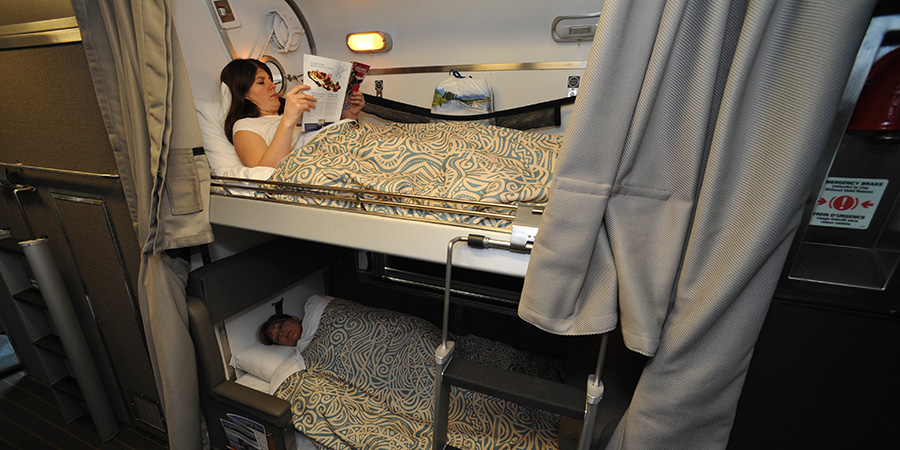
How to travel on sleeper trains like an expert
If possible, pack a lightweight cotton dressing gown and pyjamas. You may have to walk down a corridor to access the toilet in the middle of the night (depending on your cabin facilities) and semi-naked with bed hair and wearing Crocs is rarely a good look. Or maybe it is? I don't judge.
If your cabin has a shower, then it's your choice. Showering on a moving train is an adventure. The water will usually be hot but metered and so runs for a limited period of time. Consider showering during one of the extended stops (ask the conductor).
Wet shave on a moving train? Just don't. Trust me on this. It won't go well! Use an electric shaver or wait for an extended stop.
Don't hit the bar too hard. The same is true for food - you're less likely to sleep if you eat late and heavy. Coffee is your best friend in the morning and your worst enemy at night. For early risers, the train attendants may have a coffee station set up at the end of the carriage in the mornings
Get to bed as soon as possible. Snuggle up with your book, e-reader, headphones and start working on getting to sleep.
Curtains open or closed? At last, the $64,000 question. If privacy matters, keep them closed at night, but who is going to see you in the middle of nowhere? Sleeper compartment windows are usually above eyeline for those on the station platform so it's not like they'll be peering in and commenting on the furniture. I just don't care, so I leave mine open. Sometimes the external lights wake me, but I don't mind because I like to know what's going on inside and outside my little private bubble.
But most of all, embrace the adventure and enjoy the journey!